

Floating Weeds
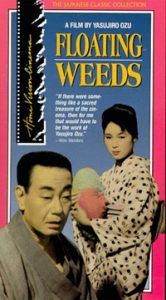
The head of a Japanese theater troupe returns to a small coastal town where he left a son who thinks he is his uncle, and tries to make up for the lost time, but his current mistress grows jealous. His name is Komajuro (Ganjiro Nakamura). He leads a traveling acting troupe that performs cut-rate kabuki in the provinces (“floating weeds” is a Japanese term for itinerent actors). His mistress Sumiko, played by the pretty and wise Machiko Kyo, is loyal to him, as are the other veteran actors, but it’s clear that the troupe is failing. As the film opens, we hear the offscreen putter of an exhausted boat engine. Then we see the troupe on the boat deck, collapsed in the shade, fanning themselves, smoking. On shore, the troupe members fan out through the town, putting up posters and staging a ragtag parade (a little boy grows so excited he must dash away and pee against a wall). The theater owner gives them cramped living quarters upstairs.
Komajuro goes to visit a woman who runs a saki bar. Her name is Oyoshi (Haruko Sugimura), and years earlier she bore the actor’s son. He is now a handsome young man named Kiyoshi (Hiroshi Kawaguchi), who works in the post office, and has been told that Komajuro is his uncle. The old actor is proud of his son, but embarrassed to admit his parentage; he wants to keep the secret. His mistress discovers the secret, is enraged, and sets a trap: She pays a pretty young actress (Ayako Wakao) to seduce the youth. The old actor of course doesn’t want his son involved with a woman of (he well knows) easy virtue. His dilemma grows thornier when the two young people fall in love: How can he exercise authority without revealing the truth?
One of six sublime color masterworks that Yasujiro Ozu produced late in his career, the director’s second filming of his own 1934 silent triumph A Story of Floating Weeds represents the mature flowering of his style. Harnessing the full expressive potential of color, sound, music, and his exquisite compositional sense, he brings new depths of bittersweet feeling—tinged with an aging artist’s melancholic nostalgia—as well as a new air of expansiveness, to a story with enduring resonance.