

The Pillow Book
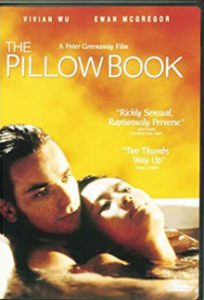
Beautiful to behold and impossible to forget, The Pillow Book is auteur Peter Greenaway’s erotically-charged homage to the art of calligraphy and the indelible nature of even our earliest memories. As a young girl, Nagiko (Vivan Wu) became her father’s canvas each year on her birthday, as he’d paint on her face and neck the creation myth in elaborate, elegant calligraphy. As a young woman, she finds pleasure in continuing the practice with a succession of lovers, particularly a bisexual translator (Ewan McGregor) who becomes a pawn in an escalating game of revenge on the publisher who once exploited her beloved father’s hard work.
The Pillow Book is a seductive and elegant story that combines a millennium of Japanese art and fetishes with the story of a neurotic modern woman who tells a lover: “Treat me like the pages of a book.” Early in Nagiko’s life, she sees something she was not intended to see: Her father’s publisher (Yoshi Oida), forcing her father (Ken Ogata) to have sex as the price of getting a book published. On another occasion, when she is 6 or 7, she is introduced to the publisher’s 10-year-old nephew, and told this will be her future husband. These events set up fundamental tensions in her life, and as an adult, unhappily married to the publisher’s nephew, she begins keeping her own pillow book. The nephew (Ken Mitsuishi) is a shallow dolt, who finds her book and in a jealous rage burns her papers and then their house.
Nagiko flees from Kyoto to Hong Kong, where eventually she finds work as a fashion model and begins to seek lovers who will fulfill her dreams. For her, the appearance of a person’s handwriting is more important than the surfaces of his face; she wants to be used as a book, to be written on, to be read.
Her fetish ties in with two ancient Japanese artistic practices. One is the art of tattooing, which can be much more elegant and artistic than in the west, and is used by the yakuza as a way of bonding with their criminal brothers. It can be seen as a form of submission–to the will of the tattoo artist, to the will of the group dictating the tattoos, or simply in the willingness of a person to be used as an object. The other practice is the long-standing Japanese tradition in art of deliberately exposing the artificiality of a work of art.